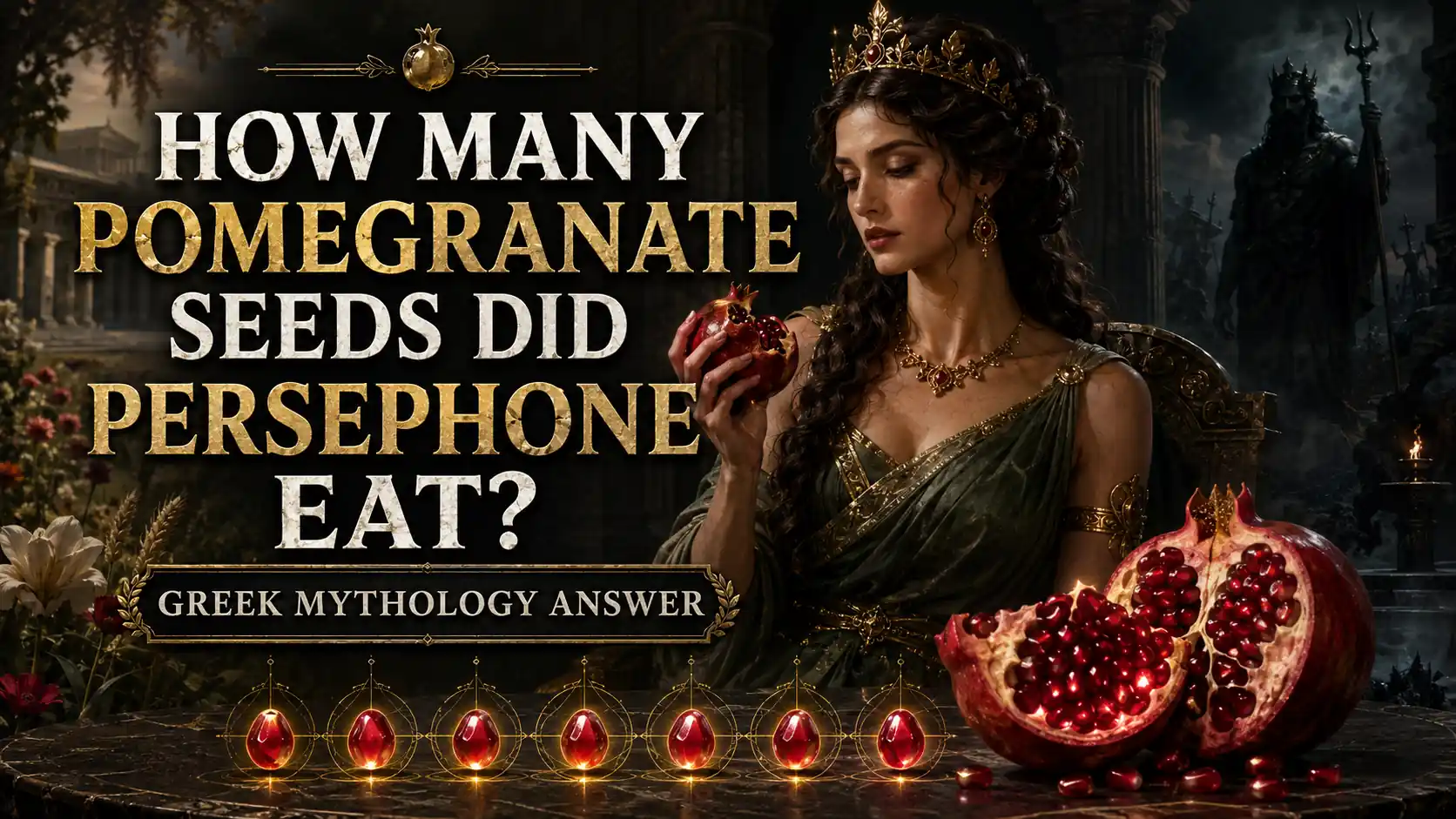
Many modern retellings say Persephone ate six pomegranate seeds, which is why she had to spend six months of the year in the underworld with Hades. But older Greek versions do not always give one fixed number. In the Homeric Hymn to Demeter, the focus is on Persephone tasting the pomegranate, not on a simple “six seeds” count.
Quick Answer
| Question | Short answer |
|---|---|
| How many pomegranate seeds did Persephone eat? | Many modern versions say six. |
| Is six the only answer? | No. Different versions give different numbers or do not clearly count them. |
| What happens after she eats them? | She becomes bound to return to the underworld for part of each year. |
| What does the pomegranate explain? | It explains Persephone’s yearly return to Hades and the seasonal cycle connected with Demeter’s grief. |
The Simple Answer
The most common simple answer is:
Persephone ate six pomegranate seeds.
This version is popular because it neatly explains why Persephone spends six months in the underworld and six months above the earth with her mother, Demeter.
But Greek mythology is not always that neat. In some ancient versions, Persephone’s time in the underworld is not exactly six months. In the Homeric Hymn to Demeter, she is connected with spending one-third of the year below and two-thirds above, not a clean half-and-half split.
That is why the safest answer is:
Six seeds is the common modern answer, but the ancient myth has different versions.
Why Did Persephone Eat Pomegranate Seeds?
In the myth, Persephone is taken to the underworld by Hades. Her mother Demeter searches for her and refuses to let the earth produce crops while Persephone is gone.
Eventually, Zeus sends Hermes to bring Persephone back. Hades agrees to release her, but before she leaves, he gives her pomegranate seed or pomegranate food to eat.
Because Persephone has tasted food from the underworld, she cannot simply return to the upper world forever. She must go back to Hades for part of each year.
Why Do People Say Six Seeds?
The “six seeds” version is popular because it matches a simple seasonal explanation:
| Seeds | Time in the underworld |
|---|---|
| Six seeds | Six months with Hades |
| Six months above | Time with Demeter and the living world |
This version makes the myth easy to understand:
- Persephone is above the earth during spring and summer.
- Demeter is happy, so plants grow.
- Persephone returns to the underworld during autumn and winter.
- Demeter mourns, so the earth becomes barren.
That is why many school versions, children’s retellings, and modern summaries use six seeds.
Did Ancient Sources Always Say Six?
No. This is where the answer gets tricky.
Ancient Greek myths were told in different versions. Some versions focus on the act of eating the pomegranate rather than the exact number of seeds. Other versions connect Persephone’s time in the underworld with one-third of the year. Later retellings often make it six months.
So when someone asks “how many pomegranate seeds did Persephone eat,” the answer depends on which version of the myth is being used.
A careful answer is:
Six is the best-known modern number, but it is not the only version of the myth.
What About Three, Four, or Seven Seeds?
You may also see other numbers online, including three, four, or seven.
These usually come from different retellings, symbolic explanations, local versions, or modern adaptations. Sometimes the number is changed to fit a different seasonal pattern. Sometimes writers choose a number because it sounds meaningful or dramatic.
For example:
| Number | Possible reason it appears |
|---|---|
| One seed | Some versions emphasize a single pomegranate seed or the act of tasting underworld food. |
| Four seeds | Sometimes linked with four months in the underworld. |
| Six seeds | The most common modern version, linked with six months below and six months above. |
| Seven seeds | Usually appears in later or modern retellings, not as the standard answer. |
This is why the number can look confusing when you compare websites.
Did Hades Trick Persephone?
In many versions, yes. Hades gives Persephone the pomegranate before she leaves the underworld, and this binds her to return.
Some retellings say he tricked her. Some say she was forced. Some modern versions make the act more willing or symbolic. The tone changes depending on the version.
In the older mythic tradition, the important point is not romance. The important point is that Persephone has eaten underworld food, so she is no longer free to remain above the earth permanently.
What Did the Pomegranate Mean?
The pomegranate is often connected with fertility, death, marriage, blood, and the underworld.
That makes it a powerful symbol for Persephone because she belongs to two worlds:
- the living world of spring, flowers, grain, and growth
- the underworld of death, darkness, and Hades
By eating the pomegranate, Persephone becomes tied to the underworld. She is no longer only Demeter’s daughter. She also becomes the queen of Hades’ realm.
Why the Number Matters
The number of seeds matters because people use it to explain how long Persephone stays below.
The simple version says:
Six seeds = six months in the underworld.
But the broader myth is more flexible:
- some versions say she stays below for one-third of the year
- some later versions say half the year
- some retellings focus on the fruit itself, not the number
- modern stories may choose different numbers for symbolism
So the exact number is less important than the rule: eating the pomegranate binds Persephone to return to the underworld.
Common Mistakes
Mistake 1: Saying every ancient source says six seeds
Six is common, but not universal. Ancient versions do not always give a clean six-seed count.
Mistake 2: Treating the myth like one fixed story
Greek mythology has many versions. Different poets, regions, and later writers could tell the story differently.
Mistake 3: Ignoring the underworld-food rule
The important mythic rule is that eating food from the underworld binds Persephone to that realm.
Mistake 4: Assuming Persephone’s choice is always described the same way
Some tellings say Hades tricked or forced her. Some modern versions make it more willing. The tone depends on the source.
Final Answer
The most common modern answer is that Persephone ate six pomegranate seeds. This is usually used to explain why she spends six months in the underworld with Hades. But older Greek traditions do not always give one fixed number. In some versions, the focus is simply that Persephone tasted the pomegranate or underworld food, which meant she had to return to the underworld for part of each year.